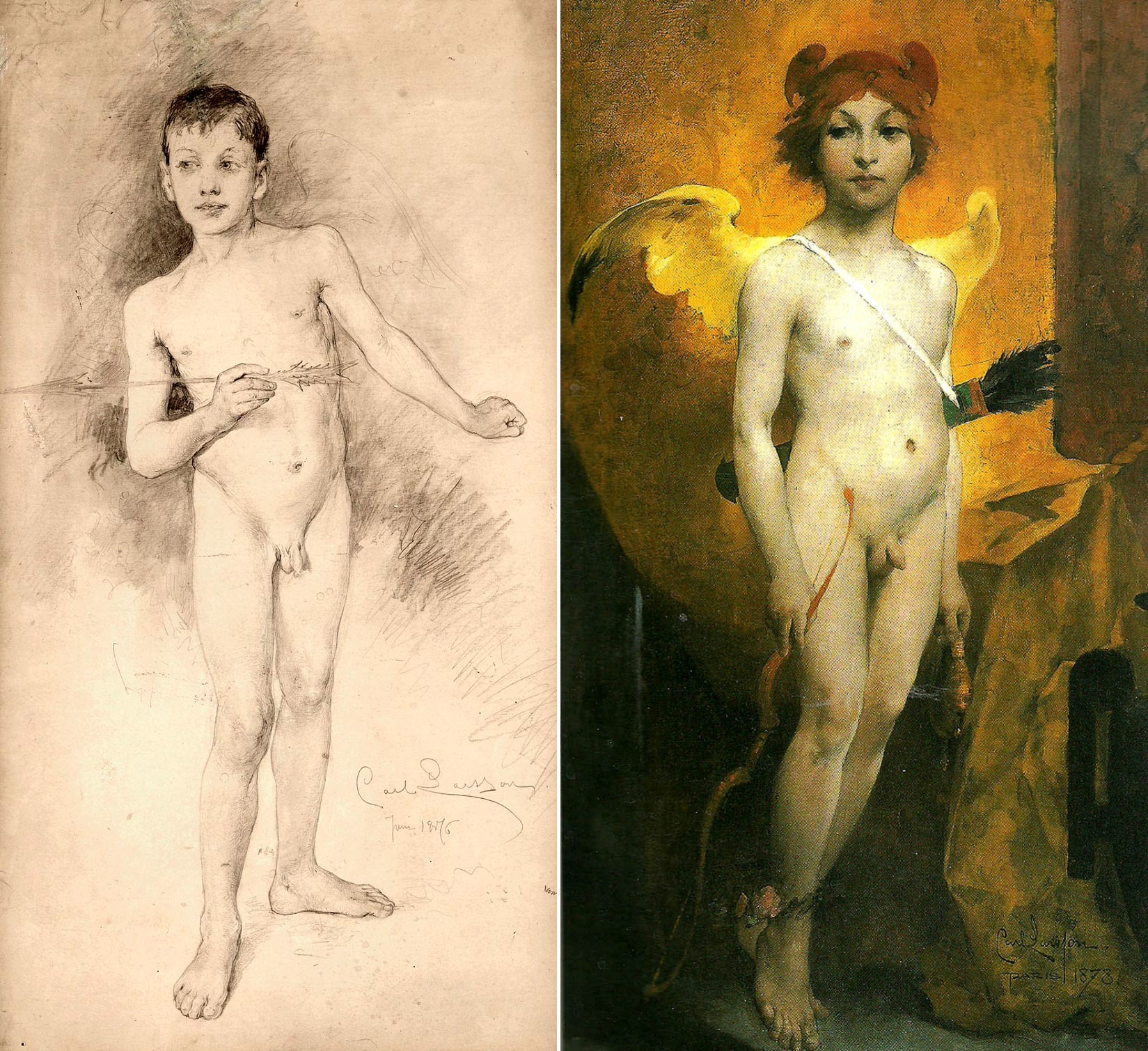
Swedish Painter Carl Olof Larsson (1853-1919) reimagined the little god Eros, assimilating him with Hermes (on the right).
Already, in Hellenistic and Renaissance art, there was a recurring motif of Eros borrowing the attributes of other gods to show that Love conquers all (Amor Vincit Omnia). It wasn’t unusual to find depictions of a “Cupid-Hermes” where a young Eros wears the petasos (winged hat) or the talaria (winged sandals) of Hermes. The two Boy Gods have, in fact, much in common.
In ancient Greek social life, Hermes and Eros were primary patrons of the Gymnasium and the Palaestra. Hermes presided over the athletic training and the cleverness of the youth. Eros presided over the bonds of friendship and the “ennobling” love between students and mentors.
Statues of both gods were frequently placed together in these spaces to suggest that physical education should be accompanied by both mental agility and the inspiration of beauty.
Both gods function as liminal figures—beings that cross boundaries. Hermes is the Psychopompos, moving between the worlds of the living and the dead. Eros is often described as a Daimon (a middle spirit) in Platonic philosophy. In the Symposium, Diotima describes Eros as a bridge between the mortal and the divine, much like Hermes’s role as the messenger of the gods. They both translate and interpret “human” needs to the “divine” realm.