Once you become familiar with the mysteriosophy of the Divine Twin (as articulated in my book), you start recognizing patterns in art and literature that reflect its core tenets. In creative endeavors, an author’s original intent is often supplanted by a meaning that exists beyond their own conscious mind. Artists, poets, and writers are not always aware of the “unintended” truths that surreptitiously infiltrate their creations from an otherworldly spring of creativity. For that reason, creators are often not the best interpreters of their creations.
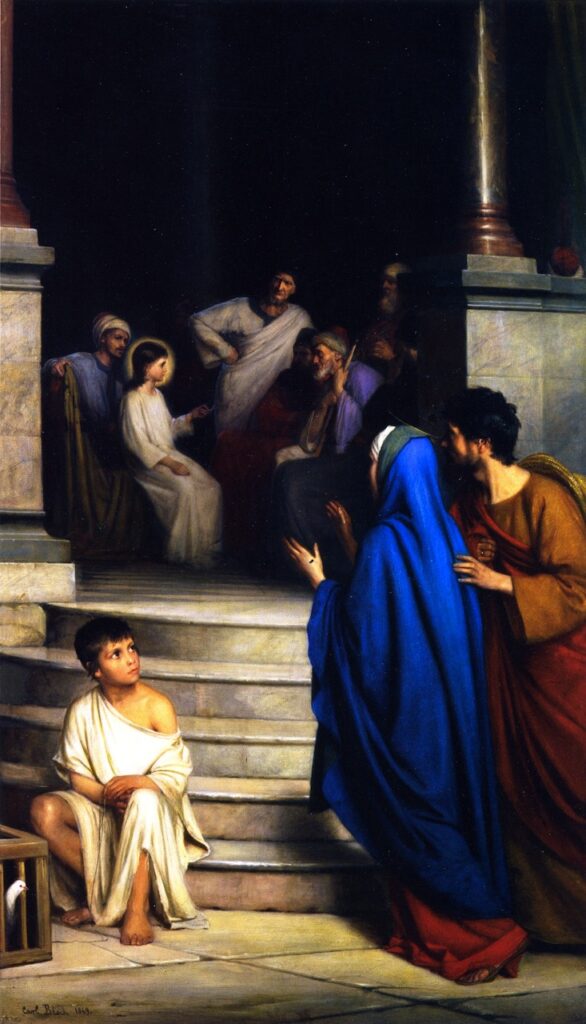
The esotericist’s task is to unveil these subtexts and bring hidden motifs to light. This is the scrutiny I want to cast on a painting of the young Jesus by Carl Heinrich Bloch. This work is part of a series of twenty-three classical canvases on the life of Christ; it is unlikely the artist intended anything more than a realistic rendering of the Gospel story found in Luke 2:46.
While the subject matter seems traditional, the composition reveals noteworthy details regarding the dynamics between the human soul and her “savior-twin.” The scene depicts the twelve-year-old Jesus conversing with learned men in the Temple—which, in esoteric thought, represents the human body (see John 2:19-21 and 1 Corinthians 6:19), the house of both soul and Spirit.
A caged pigeon or dove in the bottom-left corner is the only creature looking directly at the viewer, as if inviting us to step into the tableau and explore its secrets. Next to the cage, a young bird-seller sits at an angle on the bottom step. He stares at Joseph and Mary. They are the largest figures on the canvas, signifying the reach, power, and authority of the established Church as mediator between humankind and its redeemer. Yet, they turn their backs to the audience and move away, suggesting that the mediation of the “exoteric” (outer) church is ineffectual. With her extended hands, Mary (recognizable by her iconic blue mantle) directs our gaze toward Jesus; be must look for a direct link between the soul and its savior.
Most of the light falls on the bird-seller, marking him as a central figure. He represents the soul, child of the earth; his feet are firmly planted on the ground. If we trace an invisible axis from his spine to that of Jesus—who sits at the same angle atop the stairs—the steps become a symbolic ladder from the earthly soul to her spiritual liberator.
Indeed, the child Jesus here appears nothing like a physical being, but as a somewhat frail, ghostly figure almost about to disappear in the penumbra. He is precariously seated on the edge of his chair, as if suspended in air. With his feet hidden behind the diaphanous helm of his robe, he does not seem to be touching the ground.
In contrast to the bird-seller, the child Jesus appears almost ghostly, fading into the penumbra. He is perched precariously on the edge of his chair, his feet hidden behind the diaphanous hem of his robe, seemingly hovering above the ground. Jesus teaching in the physical temple is an allegory for the spiritual hierophant (numen) initiating the soul in the innermost sanctuary.
The dove next to the child-soul serves as a symbolic duplicate of Jesus. A dove is the recognized symbol of Spirit, while the bird is a frequent symbol of the soul. This dove is caged, alluding to the imprisonment of both the Divine Twin and the soul in the physical world. However, we hold the key to this prison. The bird-seller holds a string to lift the hatch and release the bird. This portrays a pivotal moment in the soul’s journey: the awakening of the “savior-twin” (notably, Jesus and the bird-seller appear to be the same age).
In Gnostic and dualist circles, the Holy Spirit was often seen as the Heavenly Twin or guardian angel. This twin must be awakened by the soul to become the agent of liberation. Through these dynamics, soul and Spirit become saviors to one another. Until that moment when these mystical siblings can soar together, they remain “caged birds,” prisoners of the material realm.